


ABOUT TIAS
The Institute is committed to imparting holistic development by blending knowledge, ethics, professional competence, and a socially responsible outlook. It aims to nurture individuals who can excel in a dynamic global environment. Through student-centric teaching-learning processes, along with co-curricular, extra-curricular, enrichment, extension, and outreach activities, the Institute strives to develop well-rounded professionals and responsible citizens. A strong emphasis on research and innovation further enhances the academic ecosystem.
TheDepartment of Information, Communication & Technology (DICT) is dedicated to designing and delivering cutting-edge academic programs aligned with the evolving landscape of Information & Communication Technology (ICT). Our mission is:
To serve humanity by creating professionally competent, socially sensitive engineers with high ethical values who can work as individuals or in groups in multicultural global environments.
The department emphasizes on that each Graduate passing out from the realms of Tecnia posses following Attributes:
- Computational Knowledge (CK)
- Problem Analysis (PA)
- Design / Development of Solutions (DDS)
- Communication Efficacy (CE)
- Conduct Investigations of Complex
- Computing Problems (CICP)
- Modern Tool Usage (MTU)
- Professional Ethics (PE)
- Life-long Learning (LLL)
- Project Management and Finance (PMF)
- Societal and Environmental Concern (SEC)
- Individual and Team Work (I&T)
- Innovation and Entrepreneurship (I&E)
At the core of the Institute’s Innovation Council develops a research ecosystem through the Centre of AI & Robotics, with Domain Clubs AI ML & Robotics Club, Data Science Club and Cyber Security Club— which foster innovation and technical excellence.
Key Highlights:
- Innovation-driven ecosystem under the Institute’s Innovation Council
- Research focus through Centre of AI & Robotics
- Hands-on learning via domain clubs (AI & ML, Robotics, Data Science, Cyber Security)
- Encouraging interdisciplinary research & collaboration
- Fostering innovation, creativity & technical excellence
- Bridging academia with real-world technological applications
The Department of ICT empowers students with practical exposure, industry-relevant skills, and the ability to lead in the rapidly evolving digital world.
ABOUT THE SYMPOSIUM
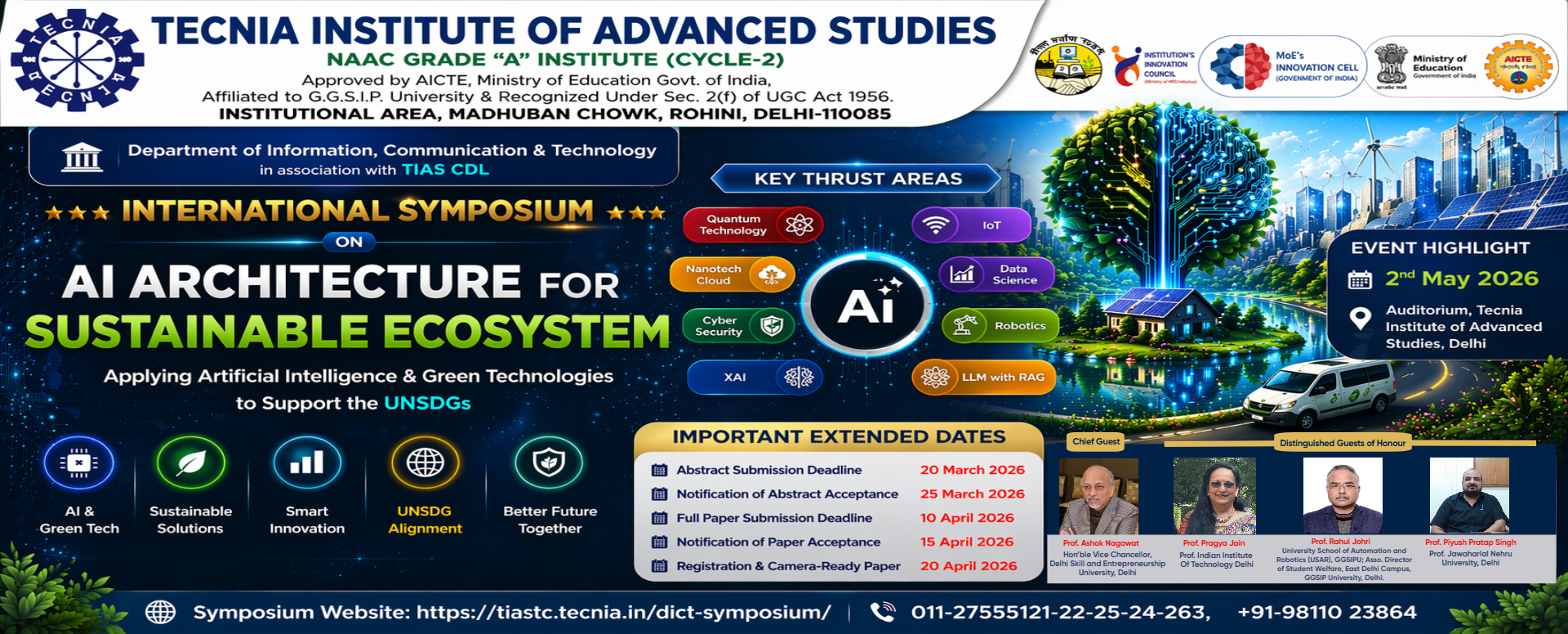
In an era where Artificial Intelligence is redefining the contours of global development, the convergence of technology with sustainability has become imperative. The concept of a sustainable ecosystem—spanning the biosphere, society, and economy—demands intelligent systems that are not only powerful but also ethical, energy-efficient, and future-ready.
Aligned with this vision, the International Symposium on AI Architecture for Sustainable Ecosystem serves as a dynamic platform to explore how AI can drive sustainable transformation across interconnected domains. Inspired by the integrated model of biosphere, society, and economy, the symposium emphasizes the role of AI in enabling balanced growth, responsible innovation, and resilient digital infrastructures.
At the core of this initiative lies the Institute’s Innovation Council, which nurtures a vibrant research ecosystem through the Centre of AI & Robotics and active domain clubs—AI & ML, Robotics, Data Science, and Cyber Security—fostering innovation, interdisciplinary collaboration, and technical excellence.
The symposium brings together academicians, researchers, industry experts, and students to deliberate on cutting-edge advancements in AI, including explainable AI, energy-efficient computing, quantum technologies, and intelligent automation. It aims to bridge the gap between academia and real-world applications while promoting ethical AI practices and sustainable technological solutions.
By integrating innovation with responsibility, this symposium envisions shaping AI architectures that not only solve complex problems but also contribute to a sustainable, inclusive, and future-ready world.
Participation Categories
The symposium will be organized into four major participation tracks:
- Research Paper Presentation (Publication Track) – For original research work, with opportunities for publication in conference proceedings or journals.
- Innovative Project – Showcase novel AI-driven projects with potential real-world impact and innovation.
- Prototype Presentation – Demonstrate functional AI prototypes or proof-of-concept systems highlighting practical implementation.
- Poster Presentation – Present research findings, ideas, or innovations in a visual and interactive format.

OBJECTIVES
- To examine the role of AI architecture in building sustainable digital ecosystems.
- To explore green AI, energy-efficient computing, and environmentally conscious system design.
- To analyze ethical, legal, and governance frameworks for responsible and sustainable AI deployment.
- To identify emerging trends and challenges in AI infrastructure and system design.
- To foster innovation, interdisciplinary research, and high-quality publications.
PUBLICATION OPPORTUNITY
- Selected high-quality papers presented at the symposium will be considered for publication in reputed journals indexed in Web of Science (WoS) and Scopus.
- Authors will also have the opportunity to publish in double-blind peer-reviewed, refereed journals indexed in Index Copernicus International (ICI) and J-Gate, with valid ISSN.
- All accepted and presented papers will be published in the conference proceedings with an ISBN.
GUIDELINES
- Abstract length shall be 300-350 words, with keywords (5-6).
- Full Paper length shall be 4000-8000 words (including references), in APA 7th edition format.
- Papers must be original and should not be under consideration for any other conference or publication.
- All submissions must be made electronically in MS Word format via the conference submission portal (link provided on the website).
OVERALL AWARDS
- Best Paper Award
- Best Innovation Award
- Young Researcher Award
- Best Poster Award
IMPORTANT DATES
- Abstract Submission Deadline20th March, 2026
- Notification of Abstract Acceptance25th March, 2026
- Full Paper Submission Deadline10th April, 2026
- Notification of Paper Acceptance15th April, 2026
- Registration & Camera-Ready Paper20th April, 2026
- Symposium Date02nd May, 2026
THEMATIC TRACKS
Researchers are invited to submit original, unpublished research papers and case studies on the following sub-themes (but not limited to):
- AI Infrastructure & Cloud in Sustainable Development: This track focuses on the application of AI in domains such as climate science, agriculture, smart cities, and renewable energy, along with eco-friendly data centers, edge computing, and scalable AI infrastructures.
- Sustainable Software Engineering and Green Computing Practices
- Edge AI for Smart Infrastructure and Urban Systems
- Internet of Things (IoT) for Environmental Monitoring
- AI-driven Automation for Smart Governance
- Explainable AI (XAI) and Responsible AI Systems
- Digital Twins for Sustainable Development
- Human-AI Collaboration and Intelligent Systems
- Energy-Efficient Cloud and Edge Computing
- Security & Privacy in Sustainable AI Ecosystems: This track explores resilient, secure, and privacy-preserving AI architectures that ensure trust, robustness, and protection in sustainable digital environments.
- Privacy-Preserving Machine Learning
- Cloud Security and Sustainable Data Centres
- Ethical Hacking and Cyber Law in AI Systems
- Zero Trust Security Models
- Security in IoT and Edge Computing
- Block chain for Secure and Transparent Systems
- Cyber Risk Management in Sustainable Infrastructure
- AI-powered Threat Detection and Cyber Defense
- AI Governance & Policy Frameworks: This track addresses regulatory compliance, ethical guidelines, and standards for sustainable AI, including aspects of waste reduction, resource optimization, and lifecycle management.
- AI Lifecycle Governance Models
- Energy Efficiency Compliance Mandates
- Ethical Standards for Green AI
- Risk-Based Regulatory Frameworks
- Resource Optimization Best Practices
- Accountability and Audit Mechanisms
- ESG Integration in AI Governance
- AI Emissions Measurement Frameworks
- Human-AI Collaboration in Sustainable Systems: This track emphasizes human-cantered AI design, focusing on user interfaces, trust-building mechanisms, and participatory approaches for effective collaboration between humans and intelligent systems.
- User-Centric Interface Design
- Trust Calibration Mechanisms
- Participatory AI Co-Design
- Augmentation Strategies for Impact
- Ethical Symbiosis Frameworks
- Scalable Collaboration Platforms
ADVISORY BOARD
- Prof. Dr. Ashok Nagawat, (Vice Chancellor, DESU, Delhi, India)
- Prof. Dr. D.P. Sharma, (Professor, Scientist & Advisor (Education, Research, & Digital Diplomacy)
- Prof. Dr. Mete Yaganoglu, (Department of Computer Engineering, Faculty of Engineering, Ataturk University, Erzurum, Turkey)
- Prof. Dr. Pragya Jain, (IIT, Delhi, India)
- Prof. Dr. Anjana Gosain, (Dean & Professor, USICT GGSIPU, Delhi, India)
- Prof. Dr. Piyush Pratap Singh, (Professor, JNU, Delhi, India)
- Prof. Dr. Anurag Jain, (Professor, USICT, GGSIPU, Delhi, India)
- Prof. Dr. Rahul Johri, (Professor & Asso. Director Student Welfare, GGSIPU, India)
- Prof. Dr. Anjana Gupta, (Director of the Equal Opportunity Cell, DTU, Delhi, India)
- Dr. Arkadeep Mitra, (Affiliation: Intel, Oregon Country: United States of America)
- Dr. Sanjay Kumar,(Scientist-E, SAG DRDO, Delhi, India)
- Dr. Anuradha Chug, (Professor, GGSIPU, Delhi, India)
- Dr. Bharat Bhushan, (Associate Professor, CSE, Sharda University, Noida, India)
- Dr. Ashutosh Pandey, (Associate Professor, DICT-TIAS, Delhi, India)
- Dr. Anshu Arora, (Associate Professor, DICT-TIAS, Delhi, India)
CORPORATE ADVISORY BOARD
- Mr. Vijayent Kohli, Ford Motor Company, USA
- Mr. Jwala Pandey, (Director, MNB Software, Noida, India)
- Mr. Sandeep Kuamr, (Director Nisthadhawani, Media & Entertainment Company)
- Mr. Sanjay Jha, (Resolution AI software Private Limited, Bangalore, India)
- Mrs. Chandra Sharma, (Director, Doc Master Private Limited, New Delhi India)
- Mr. Venkatesh Bharti, (Director, Vastav Intellects, New Delhi India )
- Mr. Rohit Saxena, (RVR Innovations LLP, New Delhi India)
- Mr. Subodh Gupta, (Microtek International Pvt Limited, New Delhi India)
- Mr. Sudarshan Bengani, (Kochartech, Banglore India)
IQAC ADVISORY BOARD
- Prof. A.K. Saini, (IQAC Coordinator, Director Development, Member Secretory, GGSIPU)
- Dr. Indrani Bhattacharya (Dean IQAC, Tecnia Institute of Advance Studies, GGSIPU)
SYMPOSIUM MEMBER
- Chief PatronDr. R.K. Gupta, Chairman, Tecnia Group of Institutions, Delhi
- PatronDr. Sandhya Bindal, Vice- Chairman, TIAS
SYMPOSIUM CORE COMMITTEE
- DirectorDr. Ajay Kumar, Director TIAS
- DeanDr. M.N. Jha, Dean Academics, TIAS
- HeadDr. Sushma Bahuguna, Associate Dean, DICT, TIAS
- ChairDr. Ratandeep Kaur, Head, Department of ICT- MCA, TIAS
- ConvenerDr. Nupur, Associate Professor, Research Coordinator DICT, TIAS
- Co-convenerDr. Vineet Srivastava, Assistant Professor, DICT-BCA-TIAS
CENTER OF AI AND ROBOTICS (COAIR)
ORGANIZING COMMITTEE
- Dr Neeta Kashyap, Associate Prof, DICT-TIAS
- Dr. Bharati Aggarawal, Assistant Prof. DICT-TIAS
- Dr. Ashutosh Pandey, Assistant Prof. DICT-TIAS
- Dr. Anshu Arora, Assistant Prof. DICT-TIAS
- Dr. Shilpa Bhandari, Assistant Prof. DICT-TIAS
- Ms. Richa, Assistant Prof. DICT-TIAS
- Mr. Gaurav Rawat, Assistant Prof. DICT-TIAS
- Mr. Sukant Vats, Assistant Prof. DICT-TIAS
- Mr. Suresh Panchal, Assistant Prof. DICT-TIAS
- Mr. Deepak Rathore, Assistant Prof. DICT-TIAS
- Ms. Garima Saini, Assistant Prof. DICT-TIAS
- Mr. Indraprakash Srivastva, Assistant Professor, DICT-TIAS
- Mr. Pradeep, Assistant Professor, DICT-TIAS
- Ms. Rajani, Assistant Prof. DICT-TIAS
- Ms. Bhawana, Assistant Prof. DICT-TIAS
- Mr. Akshit, Assistant Prof. DICT-TIAS
- Mr. Sachin Bhardwaj, Assistant Prof. DICT-TIAS
SUBMISSION GUIDELINES
- Abstract: 300–350 words with 5–6 keywords.
- Full Paper: 4000–8000 words (including references), formatted in IEEE Style
- Submissions must be original and not under review elsewhere.
- All submissions must be made electronically via the symposium portal (link available on website).
- A blind manuscript (without author details) is required for review.
REGISTRATION DETAILS
|

Payment once made will not be refunded.
- Bank NameICICI Bank
- Account NameDirector Tecnia Institute of Advanced studies
- Account No.164801001532
- IFSCICIC0001648
- Bank Branch Address24, Nwa Club Road, Punjabi Baugh Extension, Delhi- 110026
*Note: Fees include lunch, and refreshments. Publication charges (if applicable) will be informed separately after paper acceptance.
IMPORTANT POINTS
- Last date for paper submission: 6th April, 2026.
- A Participation certificate would be issued to the all participants.
- The fee includes conference material and refreshments.
- Fee does not include accommodation or local/outstation travel. No refund will be allowed for cancellations made. Outstation candidates needing assistance in accommodation (on payment) may contact the Conference
Dr. Sushma Bahuguna
Asso. Dean, DICT, Symposium Secretariat
Department of Information Communication & Technology
TECNIA INSTITUTE OF ADVANCED STUDIES
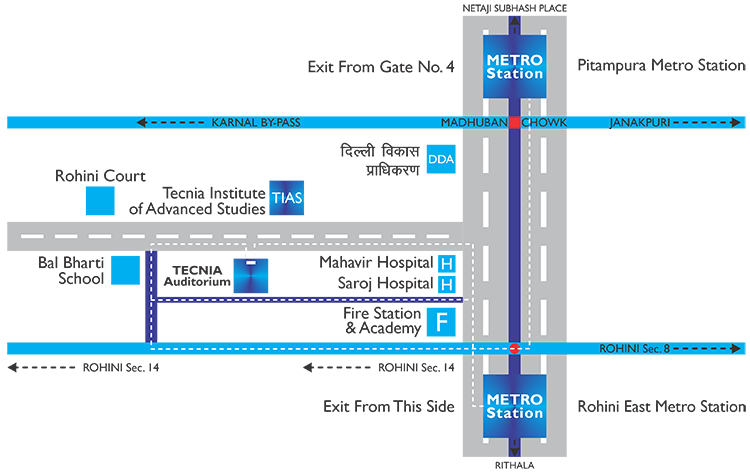
3PSP, Institutional Area, Madhuban Chowk, Rohini, Delhi-85, India
Phone: 011-27555121-2223-24 • Mobile: 9250408921 9818083607 • Fax: 27555120
Mail : dictsymposium@tecnia.in • Website : https://tiastc.tecnia.in/isaiase-2026/