

INTRODUCTION
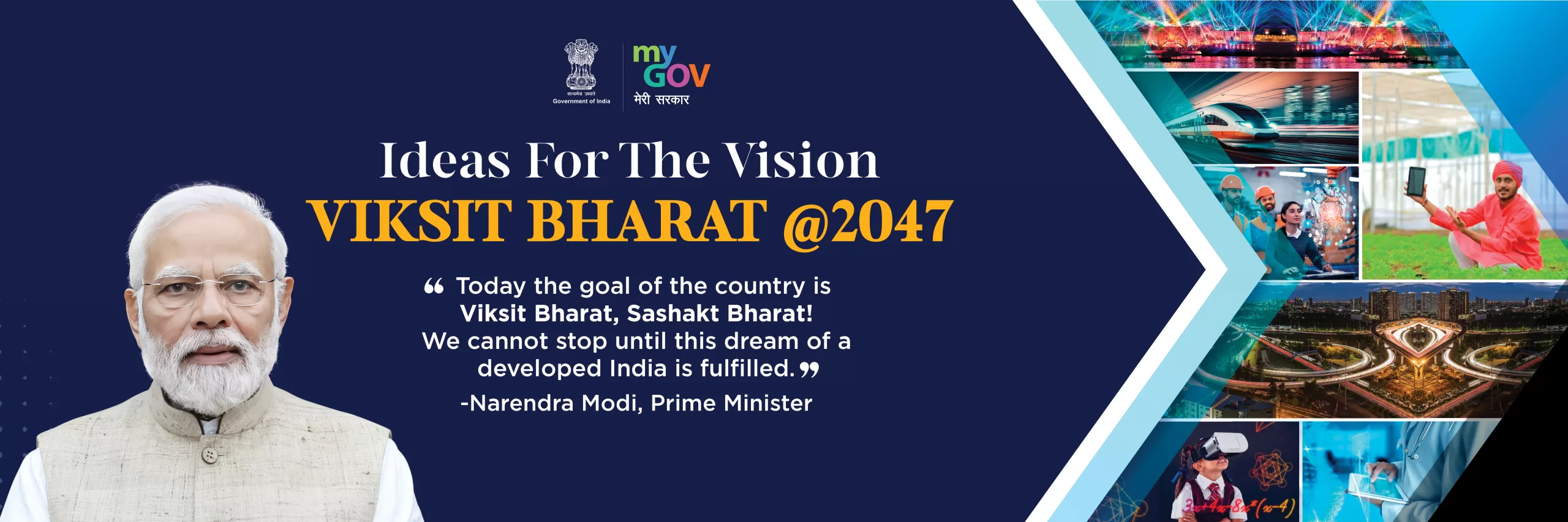
Viksit Bharat@2047 is the vision of Government of India to make India a developed nation by 2047,the 100th year of its independence. The vision encompasses various aspects of development,including economic growth, social progress, environmental sustainability, and good governance.
As India stands at this crucial juncture, poised to take off on its growth trajectory, it is important torealise that tremendous dedication and belief in India’s destiny, immense desire, potential, talentand capabilities of the Indians, especially the youth, coupled with steadfast leadership, is necessaryto realise this potential. There is enormous work that needs to be undertaken in a mission mode tomake India Viksit Bharat by 2047. For this to happen, there is a need to chalk out a bold, ambitiousand transformative agenda, and its communication to all stakeholders. The role of the youth, whoconstitute our largest population group, has a huge role here as they will lead India to Viksit Bharatby 2047.
Therefore, it is important to channelize the innovative ideas of the youth into nation- building byinviting them to ideate and contribute to the vision of Viksit Bharat by 2047. It is important thatevery youth, more so the youth in colleges/ institutes and Universities take part in this importantnation building exercise. Therefore, it is important that outreach initiative of this program reaches toevery youth in the country. Department of Higher Education, Ministry of Education will lead thecommunication and outreach in this regard.
Introduction
India is at a turning point in its history. The 21st century will be India’s century, as the country pole-vaults into the future confident of its capabilities. It is the 5th largest economy in the world today andwill be the world’s 3rd largest economy by 2027, as its GDP crosses US$ 5 trillion (IMF estimates). By2047, India is poised to be a US$ 30 trillion economy with all the attributes of a developed nation. It willbe a Viksit Bharat.
Importance of Transformative Moments
In the histories of nations, there comes a turning point, when a nation grabs the moment and achievesrapid growth. Some of these are:
- Japan: Post World War II, Japan underwent a remarkable transformation in the 1950s and 60s, aperiod of rapid economic growth never seen before, often referred to as the ‘Japanese Post-WarEconomic Miracle’. This era propelled Japan into a leading world economy and established it as a globaleconomic powerhouse.
- Germany: Germany’s economic trajectory changed in the 1950s, 60s and 70s, also known as theWirtschaftswunder or ‘economic miracle’, a period of rapid economic growth and rising living standards.Germany has since remained among the largest and most competitive economies globally, known for itsstrong manufacturing base and technological prowess.
- Singapore: From being a developing country, Singapore transformed itself in the 1960s and 70s,becoming one of the richest nations in the world, and one of Asia's economic powerhouses which istechnologically sophisticated.
- South Korea: From being a war-torn, agrarian and impoverished country in ruins, South Koreatransformed its economy dramatically from the 1960s to 90s, a period referred to as the ‘Miracle on theHan River’ with world leading companies.
These are nations which knew the importance of a turning point and used that occasion to becomeeconomic giants. India too is at the cusp of such an opportunity.
INDIA’S OPPORTUNITY – Its Turning Point
This is India’s Amrit Kaal. India has been transformed on many fronts and is ready for take-off. There hasbeen a massive expansion in social and economic infrastructure
through policies and schemes in past years such as Samagra Shiksha and expansion of Universities, IITs,IIMs, Medical and Nursing Colleges, Skilling (Pradhan Mantri Kaushal Vikas Yojana), and many more. Inthe last decade, the number of universities and colleges have increased manifold, and the Indian highereducation system today boasts 1,113 Universities/University-level Institutions, 43,796 Colleges, and11,296 stand-alone Institutions with 4.33 crore students. The Gross Enrolment Ratio (GER) in highereducation has steadily increased to 28.4.
Similarly, the healthcare sector has expanded massively on all fronts. In 2022, there were 1,56,000Ayushman Bharat centers, providing primary health care services to communities closer to their homes.The vast network of nearly 13.97 lakh Anganwadi centers covers almost 10 crore children with EarlyChildhood Care & Education. Various health indicators such as Infant Mortality Rate (IMR), MaternalMortality Rate (MMR), and percentage of children underweight have fallen dramatically. Over 10 crorewomen and children are covered under the Poshan Mission launched in 2018. Full immunisationcoverage has risen from 62% to 81% due to strengthened immunisation programmes under MissionIndradhanush. Going forward, we need to raise healthcare to global levels.
Rural India too is transforming. We are close to achieving or have already achieved universal coverage inelectricity, drinking water, bank accounts, roads, mobile connectivity and many more. Rural India is nowstarting to have the same benefits of Urban India. We have also strengthened and avoided distress forthe poor through Pradhan Mantri Garib Kalyan Anna Yojana and MNREGA. Pradhan Mantri Awas Yojanais providing housing for all.
Progress has been phenomenal on other fronts as well. Mobile phone and internet penetration ismassive. India has 120 crore mobile phone users and 80 crore internet users. India has 30 crore Unified
Payment Interface (UPI) users with 1,000 crore transactions per month. Over 40% of all digitaltransactions are on UPI. There has been a massive expansion of the Highway network with Expresswaysalso coming up. Railways have improved both capacity and bringing new trains such as Vande Bharatspeeding up travel in a better environment. Air travel has expanded and is breaking records. In Science& Technology too, we have set new milestones through Chandrayaan and other space missions. OurDigital Public Infrastructure (DPI) is the envy of the world with Aadhaar, UPI, AA Stack, COWIN platform,GeM, and many more. In Industry, we are on our way to becoming a manufacturing hub for the world.In Services, where we are very strong, our IT and non-IT sectors are becoming global.
Young India’s creativity and potential for innovation coupled with supportive government policies likeDigital India and Startup India are enabling youth to become job creators. India is home to over 100unicorns with a total valuation upwards of US$ 340 billion and has emerged as the world’s 3rd largeststartup ecosystem.
While all these point to the takeoff moment we are in now, the most important is our demographicdividend. With a population of 144 crores, India is one of the youngest nations with a median age of 29years. It accounts for nearly 20% of the world’s total young population. This is an enormous opportunity,likely to last till 2047. Using this dividend well, we can propel India into a Viksit Bharat.
India has Demonstrated& QUANTUM LEAP CAPABILITIES
The last decade has witnessed a phenomenal demonstration of our capabilities to transform India. Acomprehensive governance model focused on leaving no one behind with targeted schemes has led to13.5 crore escaping multi-dimensional poverty, much ahead of the 2030 Sustainable DevelopmentGoals. Some transformative impactful initiatives that are proof that ‘we can do’ are:
- Sports – Through concerted efforts of Khelo India, we are breaking past records and have crossed the100-mark in medals in the recent Asian Games.
- Jan Dhan Accounts – In a short period, we added 40 crore bank accounts ensuring financial inclusion,something that people expected would take years.
- COVID Vaccines – The COVID vaccination programme, run through the COWIN platform, withindigenous COVID-19 vaccines, was the world’s largest vaccination programme delivered to 200 crorerecipients flawlessly. This is a public health achievement without a parallel in human history. We alsohelped save millions of lives across the world through the Vaccine Maitri initiative, providing 23.5 croreCOVID vaccines free of cost to 98 countries. This is a testament to India’s commitment to global healthand wellbeing.
- Chandrayaan – India’s Mission to the Moon and becoming the first country to land on the South Poleof the moon demonstrated our excellence in science, breaking boundaries in an economical way. Thishas surprised the leading nations of the world and is an inspiration for what can be achieved on a limitedbudget and an encouragement for the great tasks that lie ahead in science and technology. India’sunique model of frugal innovation can be characterised as ‘affordable excellence’ and is a beacon forother countries.
- Climate Goals – India is the only country which has overachieved its Paris 2015 climate commitments9 years ahead of time by meeting 40% of its power capacity from non-fossil fuels. This has raised ourglobal standing.
- Digital Public Infrastructure – The DPI we set up has been expanded at a blinding speed, allowing Indiato be a world leader in digitisation.
- Infrastructure Expansion – The rapid expansion of state-of-the-art infrastructure is another exampleof improved capabilities. In the last 9 years, the pace of railway track construction increased more than3 times from 1,452 km/year to 5,243 km/year. The National Highways Network has increased by 60% to1,45,240 kms. There has been 100% growth in Airports from 74 to 148.
- India’s Global Standing – As a world leader, our Presidency of the G20 saw the world respectingIndia’s diplomatic and organisational capabilities. We took G20 sessions to every corner of India and theNew Delhi Leaders’ Declaration is a milestone in India’s history. With India’s global standing rising,international institutions like the International Solar Alliance are now being set up in India andinternational investors are coming to India in large numbers. In many ways, India is leading the world.
These dramatic improvements have happened because of a comprehensive governance model thatfocused on leaving no one behind with speed of service delivery, transparency of operations andfocusing on impact at the grassroots and on outcomes. This is also because of a singular commitment toa long-term vision for India.
Journey Ahead – Viksit Bharat@2047
As India stands at this crucial juncture, poised to take off on its growth trajectory, it is important torealise that tremendous dedication and belief in India’s destiny, coupled with steadfast leadership, isnecessary to realise this potential. There is enormous work that needs to be undertaken in a missionmode to make India a Viksit Bharat by 2047. For this to happen, there is a need to chalk out a bold,ambitious and transformative agenda.
Business as usual will not do. We must create the future. It is important to channelise the innovativeideas of youth into nation-building by inviting them to ideate and contribute to the vision of ViksitBharat by 2047. This outreach initiative provides that very opportunity to lakhs of youth across India.Each one of you can think about it and send your suggestions through answering 2 questions:
- How should a Viksit Bharat look like in 2047 in different aspects?
- What do we need to do to reach those goals?
- Empowered Indians
- Thriving and Sustainable Economy
- Innovation, Science & Technology (Research & Development, Digital, Startups)
- Good Governance and Security
- India in the World
VIKSIT BHARAT Sankalp Yatra
Hamara Sankalp Viksit Bharat is a nationwide campaign to raise awareness through outreach activitiesto achieve saturation of schemes of Govt. of India across the country covering all Gram Panchayats,Nagar Panchayats and Urban Local Bodies with the objectives of:
- Reaching the unreached – reach out to the vulnerable who are eligible under various schemes but havenot availed benefit so far
- Dissemination of information and generating awareness about schemes
- Learning from the citizens – Interaction with beneficiaries of government schemes through theirpersonal stories/ experience sharing
- Enrolment of potential beneficiaries through details ascertained during the Yatra.
The campaign is being taken up by adopting a whole of government approach with active involvementof various Ministries/Departments of Government of India, State Governments, Central Govt.Organizations and Institutions to ensure the widest possible participation of all concerned for thebenefit of Citizens of the country and to realize the vision of Viksit Bharat.
More Information https://viksitbharatsankalp.gov.in/
FLAGSHIP SCHEMES
|



PROGRAMME OFFICER’S
|

COMMITTEE
|
Minutes Of Meeting
|
VOLUNTEERS
|
ACTIVITY PLAN
|
NOTICES
|
FORM
|
UNIVERSITY NOTICES
|
photo gallery
Downloads
|

Award Accolades
|