


National Conference 2020
ABOUT TECNIA
Tecnia Institute of Advanced Studies (TIAS); with you all. Almost 2 de cade s ago, o u r Organization made its h umbl e begi n n i ng. Today, our students and scholars are spread across the globe as IAS, IPS, MNCs, Technocrats, Media Persons and their contribution makes a difference everywhere. Tecnia Institute of Advanced Studies (TIAS), one of the Premier Institiue is NAAC Accredited “A” Grade Institute duly Approved by All India Council for Technical Education, Ministry of HRD, Govt. of India and is affiliated to Guru Gobind Singh Indraprastha University, Delhi; Recognized under Section 2(f) of UGC Act, 1956 established in the country’s capital in the year 1998 as an educational and professional center, with an aim to provide technical knowledge required for career development of young generation by way of providing the quality education. Tecnia Institute of Advanced Studies (TIAS) – is ISO 9001:2015 & ISO 14001:2015 certified institute for its Quality Management system (QMS), Environmental Management system (EMS), for its well established system and procedures for imparting quality education in MBA, MCA, BBA & BA(J&MC) Program.
Professional education systems play a major role in the development of any society and its economy. Within the Education 2030 Agenda, UNESCO supports Member States in building knowledge-based economies, which provide sustainable employment opportunities and good standards of living for all.
Professional education strategies not only reiterate the values shared by the education system stakeholders, they provide a “health-check” of the system, compare its performance against others and particularly those that are well-performing, communicates goals and future orientations, and expresses political commitments to advancement in this field.
Over the last two decades, quality assurance, research and innovation in professional education has gained significant momentum worldwide. Major drivers for this momentum include: increased public demand for better performance of professional education institutions, widening of access and a clear call from stakeholders for greater efficiency and accountability, the need for better quality graduates to drive national economies, better use of public resources for professional education and increasing cross-border provisions.
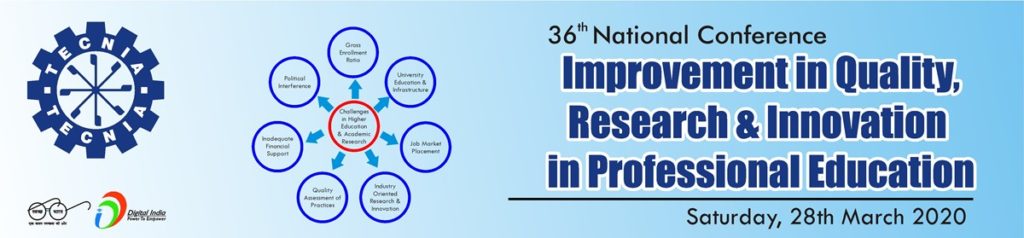
Challenges include: a mismatch between professional education graduate skills and those demanded by the labour market and industry, an imbalance between the number of students studying management and those in arts-based courses, and the proliferation of private providers.
For this reason, UNESCO and its Member States are building capacity for quality assurance in Higher & Professional education, particularly in developing countries like India. This involves putting in place and/or strengthening appropriate quality assurance systems and regulatory frameworks with the involvement of all the stakeholders.
National Institutional Ranking Framework (NIRF), National Assessment and Accreditation Council (NAAC) and National Board of Accreditation (NBA) have designed ranking and rating methods for accrediting programs as well as Institutions/ Universities for enhancing global quality standards in education. The compliance with specific norms is mandatory for all i.e. autonomous universities, deemed universities and other institutions for quality sustenance. The culture of research and innovation is being cultivated by various statutory bodies through provisions made for research project grants and boosting consultancy. Introduction of ‘Smart India Hackathon’ and the ‘Innovation Cell’ by AICTE are few steps in this direction. A specific National Policy on Skill Development launched by the Government of India also aims at honing the pragmatic knowledge and skills of the students to grab better employment opportunities in today’s competitive corporate world. Quality Enhancement in Higher Educational Institutions is an unending journey towards excellence.
Professional education is central to socio-economic development, and vital to competitiveness in an increasingly globalizing world. The principles guiding the Education 2030 Agenda: “Towards inclusive and equitable quality education and lifelong learning for all underscores the importance of establishing robust quality assurance systems to address the above challenges. To this end, UNESCO supports national policies to improve quality assurance and in order to do so engage with policymakers, educationalists, quality assurance professionals and other regulatory bodies and stakeholders.
CALL FOR PAPER
Original Research Papers (both empirical and conceptual) are invited from academicians, industry practitioners and research scholars engaged in the field of business and management. The conference discussionmay include the followingandthe relatedareas:
- Promoting research and innovations in Professional Education.
- Quality mandate and teachers training in Professional .
- Learning Outcome Based Curriculum Framework (LOCF) in HEIs.
- Induction Training of newly recruited teachers.
- Annual Refresher Training of the teachers using the SWAYAM.
- Create an innovation culture and eco-system.
- Vocationalisation of higher education.
- Digital initiatives .
- Encourage use of digital learning resources among students and teachers.
- e-Shodh Sindhu.
- National Digital Library.
- National Academic Depository.
- Ethics in research and provisions for checking plagiarism.
- motivate the students/teachers for striving for academic excellence.
- Refresher Training of all the teachers using the SWAYAM .
- Unnat Bharat Abhiyaan.
- Designing capacity building for Professional Education.
- Strengthening for evaluation, accreditation, and certification.
- Establishing comprehensive academic information systems; .
- Dynamics of Higher Education and Research for Societal Change .
- To ensure equity, access and quality in Professional education.
- Strategies of Raising the Quality of Professional Education.
- Attaining Equality of Educational Opportunities .
- The concept of excellence in Professional education.
- Sensitize the students and encourage them for their active participation in social / economic betterment of the community .
- Enhancement and Recognition of Teaching and Learning in ProfessionalEducation.
OBJECTIVE OF THE CONFERENCE
Professional education systems play a major role in the development of any society and its economy. Professional education strategies not only reiterate the values shared by the education system stakeholders, they provide a “health-check” of the system, compare its performance against others and particularly those that are well-performing, communicates goals and future orientations, and expresses political commitments to advancement in this field. Professional education is central to socio-economic development, and vital to competitiveness in an increasingly globalizing world. The objective of this Conference is to invite the practicing scholars from national and international boundaries and provide a platform to LEARNCONNECT – ENGAGE – GET INSPIRED, and provide valuable inputs in the field of Quality, Research and Innovation in professional Education.
PARTICIPANTS PROFILE
Academic Fraternity, Students, Research Scholars & Professionals fromIndustry and Research in the areas of Management, IT, Media, LIS, Health Sciences & Medicine, Agriculture, Insurance, Banking; Publishers; IT and Information Service Providers.
CONFERENCE PATRON-IN-CHIEF
CONFERENCE CONVENER
ADVISORY COMMITTEE
-
- Prof S S Handa, Professor, ISI Delhi.(Retd.).
- Prof. M. K. Soni, Pro VC, Manav Rachna International Univ., Faridabad.
- Prof G N Tiwari, Professor, IIT, Delhi (Retd.). Prof Dr R C Singh, Professor, MGCGV, Chitrakoot (Retd.).
- Prof. Sunil Gupta,Professor, IGNOU, Delhi. Dr. Nasib S Gill, Professor, M D University, Rohtak.
- Prof. Mukesh Dhunna , Professor, M D University, Rohtak.
- Prof R P Tulsian, Delhi University.
- Prof M. P. Gupta, Former Dean, FMS, Delhi.
- Prof. A K Bardhan, FMS, Delhi.
CONFERENCE CO-CONVENER
- Dr. Sandeep Kumar.
- Dr. Leena Jenefa.
FACULTY COMMITTEE
- Dr. Ajay Pratap Singh
- Dr. Varun Kumar
- Dr. Sachin Sabharwal
- Dr. S. Chinnathambi
- Dr. Arun Bhatia
- Dr. Monisha
- Dr. Shambhoo Sharan
- Dr. Vandana Raghav
- Dr. Vishal Khatri
- Dr. Namita Mishra
- Dr. Surbhi Jain
- Dr. Kanika Gupta
- Dr. Rohtash Kumar
- Dr. Sanjay Srivastava
- Dr. Vipul Partap
- Dr. Sheetal Badesra
- Mr. Mohit Tiwari
- Mr. Anil K Jharotia
- Ms. Komal Gangi
- Ms. Shalini Guliani
- Ms. Punitika Batra
- Ms. Shilpa Bhandari
- Ms. Kirti Miglani
- Ms. Megha Mohan
- Ms. Sonia Batra
- Mr. Mayank Arora
- Ms. Sania Kukkar
- Ms. Geetika
- Ms. Manisha
- Ms. Keenika Arora
- Ms. Rajni Bansal
- Ms. Neha Solalki
- Mr Rahul Tripathi
- Ms. Honey Shah
- Mr. Pradeep Palei
- Ms. Sakshi Kichlu
- Mr. Rahul Mittal
- Ms. Mansi Chopra
- Mr. B.K Mishra
Registration Fee Details (Please mark (v) accordingly):
Research Scholar : Rs. 1000/-
Academicians : Rs. 1000/-
Corporate Delegate : Rs. 1500/-
All Drafts should be in favour of “Tecnia Institute of Advanced Studies”
Payable at New Delhi.
For ONLINE TRANSFER:- Beneficiary Name: Tecnia Instittute of Advanced
Studies BJMC; Bank A/c No.: 53001143127; Bank Name: State
Bank of India;
IFSC Code: SBIN0030432; Bank Address: Sector-14, Rohini, New Delhi
Please Note:
- Please fill the form neatly in capital letters.
- Last date for receiving the registration forms: 27th February, 2020
- The fee includes conference material and refreshments. A certificate would be issued to the participants
- Fee does not include accommodation, local/outstation travel. No refund will be allowed for cancellations made.
- Outstation candidates needing assistance in accommodation (on payment) may contact the Conference Convener at the address given below.
Kindly send your Registration Form and DD by post to:
Dr. Ajay Kumar, Conference Convener,
Dr. Sandeep Kumar: 9818083607 & Dr. Leena Jenefa: 9025715473 Conference Co-Convener
TECNIA INSTITUTE OF ADVANCED STUDIES
T: 011-27555121-24 • M: 9811718422, 9910205775
GENERAL INSTRUCTIONS FOR PAPER SUBMISSION
- Contributors are requested to ensure that their paper should not exceed 8 Printed pages. The paper should be typed in Times New Roman (12 pts.) font on one side of A-4 paper in double line spacing with wide margins.
- One paper should not contain more than two authors.
- All charts and graphs should be drawn and labeled clearly.
- Only those references, which are actually used in the text, should be included in the reference list.
- The contributor should certify on a separate sheet that the manuscript is his/her original contribution. It should be mentioned that the paper has not been submitted or accepted for publication anywhere else
- Paper should contain abstract not more than 500 words along with key words.
- Paper, Abstract and registration form must be sent at events@tecnia.in.
- Innovative Higher Education For Skills Enhancement
- A future that works: automation, employment, and productivity of Higher Education
CONFERENCE PROCEEDINGS
The blind reviewed conference papers will be published in the conference proceedings (full paper) bearing an International Standard Book Number (ISBN).
LEARN * CONNECT * ENGAGE * GET INSPIRED
The body of tools, techniques, and methods that quality encompasses is ever growing, and the digital transformation of today is filled with opportunity to expand the development of new approaches that will affect how quality, research and innovation principles are applied tomorrow.
IMPORTANT DATES
- Conference Date: 28th March, 2020.
- Last date of submission of Abstract 30th January 2020.
- Confirmation about acceptance of Abstract 5th February 2020.
- Last date of complete paper submission 22th February 2020
- Last date for registration and confirmation about paper presentation in th person- 28 thFebruary 2020